
The MCX Stock Exchange has dragged the market regulator to court. In a writ petition filed on July 16 in the Bombay High Court, the exchange has sought a response from the Securities and Exchange Board of India on its application for permission to operate as a full-fledged stock exchange.

India's stock exchanges have decided to jointly introduce the T+1 settlement cycle in phases from February 25, beginning with the bottom 100 stocks by market capitalisation. From March 2022, on the last Friday (or the immediate next trading day) of every month, the next 500 stocks from the bottom will be subject to T+1 settlement. The phase-wise implementation is expected to give all market participants, including foreign portfolio investors (FPIs), ample time to shift to the shorter cycle. The settlement cycle represents the time period within which the stock exchanges have to settle security transactions.

There are thousands of stocks within the NSE, for example, that are rarely traded.

When Gensol Engineering made its public market debut through a small and medium enterprises (SME) initial public offering (IPO) in September 2019, its promoters held a commanding 96 per cent stake. Now, that figure has shrunk to a "negligible" fraction.

Trump stated that Russia will face "severe economic consequences" if Putin doesn't show interest in de-escalating the Ukraine conflict.

In the hottest sector of AI, where most global VC funding is going currently, the country's record has not been anything to write home about.

A higher TER means a larger portion of the return goes to the AMC, leaving less for the investor, unless compensated by higher returns.

Capital market regulator Sebi on Tuesday rejected the competing open offer made by the US-based entity Danny Gaekwad Developments & Investments for acquisition of Religare Enterprises Ltd (REL) as it did not meet necessary regulations.

India and Russia always stood "shoulder-to-shoulder" even in the most difficult situations, Prime Minister Narendra Modi told Russian President Vladimir Putin on Monday, against the backdrop of possibly the worst phase in New Delhi's ties with the US in over two decades.

Two 'very smart' leaders of India and Pakistan decided to end last month's conflict that could have turned into a nuclear war, United States President Donald Trump said after holding a rare luncheon meeting with Pakistan army chief Field Marshal Asim Munir at the White House.

Stock market regulator Securities & Exchange Board of India (Sebi) has widened the scope of index-based options by allowing exchanges to offer option contracts based on Sensex and Nifty with a tenure of up to five years.

Front-running is a fraudulent practice where traders exploit advance knowledge of large client orders for personal profit.

Many affluent young people are first-generation wealthy. They have limited financial literacy, lack quality financial guidance or role models, and often fall prey to mis-selling. This makes them hesitant to invest in high-return assets like equities.

Capital markets regulator Sebi on Monday came out with a framework for operationalising the gold exchange, wherein the yellow metal will be traded in the form of electronic gold receipts (EGRs). The stock exchange desirous of trading in EGRs may apply to Sebi for approval of trading in the new segment, the regulator said in a circular. The bourses can launch contracts with different denomination for trading or conversion of EGR into gold. Under the new framework, the entire transaction has been divided into three tranches-- creation of EGR; trading of EGR on stock exchange and conversion of EGR into physical gold.

Naved Masood, former secretary in the Ministry of Corporate Affairs and Sebi board member; TV Mohandas Pai, chairman of Manipal Global Education and Dinesh Kanabar, CEO, Dhruva Advisors have ceded their position on the NSE board following end of their tenure.

Mutual funds (MFs) reinforced their record monthly inflows in October with an investment of Rs 87,000 crore (up to October 29), softening the downside pressure on domestic markets. Their prior record for monthly inflows was Rs 48,139 crore in May. This unprecedented monthly buying partially countered record monthly sales by foreign portfolio investors (FPIs) of Rs 1.1 trillion last month.

The ban on listing and other roadblocks on ownership have tainted the Jalan Committee report.
The government said on Thursday said it will make it clear within 10 days whether foreign players be allowed to hold stake in stock exchanges or not.

Physics Wallah has filed Draft Red Herring Prospectus (DRHP) with the Securities and Exchange Board of India (Sebi), a precursor to hitting the primary market from where the edtech Unicorn reportedly plans to raise around Rs 4,500 crore through IPO.

While the country imposed limits, it also eased and simplified other restriction to attract foreign inflows. This is done to plug record current account deficit.

LIC said USTR's views are based on an incomplete understanding of Indian insurance regulation and LIC's functioning.

The Indian government has appointed Finance Secretary Tuhin Kanta Pandey as the new chairman of the Securities and Exchange Board of India (SEBI). Pandey, a 1987-batch IAS officer, will replace Madhabi Puri Buch, whose three-year tenure ends on February 28. Pandey's appointment comes at a time when the markets are experiencing bear pressure due to withdrawals by foreign institutional investors (FIIs). Pandey has extensive experience in the finance ministry, having served as the longest-serving secretary in the Department of Investment and Public Asset Management (DIPAM) and the Department of Public Enterprises (DPE). He also played a key role in the framing of the 2025-26 Budget and the drafting of the new Income Tax Bill. Pandey's appointment is for an initial period of three years.

India and New Zealand have signed a pact to institutionalize their defence ties and vowed to boost cooperation in the Indo-Pacific. Prime Minister Narendra Modi raised concerns about anti-India activities by some illegal elements in New Zealand with his Kiwi counterpart Christopher Luxon. The two sides also signed six agreements to enhance cooperation in areas including education, sports, agriculture, and climate change. They also agreed to prepare a roadmap for cooperation in the defence industry sector and explore early implementation of cooperation in the digital payments sector.
The Bombay Stock Exchange is set to see a reshuffle in its board of directors, the first since the country's oldest bourse was demutualised and became a limited company last year. The reshuffle, details of which are yet to be discussed, is widely believed to be at the behest of market regulator Securities and Exchange Board of India.

The share of Ahmedabad in the total value of trades on both the BSE and NSE is set to touch double digits for the third year in a row.

The objective is to ensure the exchange's preparedness in the event of a natural calamity, so that any disruptions should not affect market integrity and investor confidence.
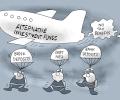
Alternative investment funds (AIFs) - investment vehicles favoured by the affluent - have topped $50 billion (Rs 4.3 trillion) in total investments for the first time during the April-June quarter, according to the latest data from the Securities and Exchange Board of India. The industry's commitments have approached Rs 12 trillion ($140 billion), marking a 40 per cent increase over the past year. The amount raised and deployed stood at Rs 4.74 trillion ($56 billion) and Rs 4.32 trillion ($51 billion), respectively, the data shows.

The country's total debt, or the total outstanding bonds which are being traded in the market, rose to $2.47 trillion (Rs 205 lakh crore) in the September quarter, according to a report. The total debt amount in the March quarter of the previous fiscal was $2.34 trillion (Rs 200 lakh crore). The central government's debt stood at $1.34 trillion, or Rs 161.1 lakh crore, in the September quarter, up from $1.06 trillion, or Rs 150.4 lakh crore, in the March quarter, Vishal Goenka, co-founder of Indiabonds.com, said, quoting data provided by the Reserve bank of India.

Anant Ambani, the youngest son of billionaire Mukesh Ambani and the first among three siblings to be appointed executive director on flagship Reliance Industries, will be paid Rs 10-20 crore salary annually plus a host of perks including a commission on company profits, according to a shareholder notice. While the richest Asian's all three children - twins Akash and Isha, and Anant - were inducted on board of the oil-to-telecom-and-retail conglomerate in 2023 as non-executive directors, the youngest of the three was in April this year appointed executive director of Reliance Industries Ltd.

Specialised investment fund (SIF), a new asset class, will have the same expense structure as that of mutual funds (MFs), according to rules notified by the Securities and Exchange Board of India (Sebi). SIF, which was first proposed by Sebi in July 2024, aims to fill the gap between MFs and portfolio management services (PMS), and it looks at informed investors, who are willing to take riskier bets.

Fundraising by Indian corporates through equity and debt reached all-time high in the calendar year 2024, according to primedatabase.com. The overall public equity fundraising stood at Rs 3.7 trillion in 2024, a rise of 159 per cent from Rs 1.4 trillion in 2023. If Rights Issues of Rs 25,973 crore were to be added, the overall equity fundraising would touch nearly Rs 4 trillion in 2024.

Leading brokerages have revised their charges with the true-to-label norms by the Securities and Exchange Board of India (Sebi) kicking in from Tuesday.

The Securities and Exchange Board of India (Sebi) is likely to notify soon stricter derivatives trading norms aimed at curbing speculative trading activity and curtailing losses of over Rs 50,000 crore incurred by retail investors every year. Based on the feedback received from industry participants, seven measures proposed by the market regulator in a consultation paper in July may be implemented with minor tweaks ahead of its forthcoming board meeting, said sources.

Regulator proposes mutual fund model for infrastructure debt funds.

The Securities and Exchange Board of India (Sebi) has proposed to put a stop to the practice of certain directors occupying permanent board seats at listed companies. The regulator has suggested that the directorship of any individual serving on the board should be subject to periodic approval from shareholders, at least once in five years. In a discussion paper issued on Tuesday, Sebi said a few promoters enjoyed permanency on the board, giving them an undue advantage, prejudicial to the interests of public shareholders.

The exchanges have also been asked to post all such orders since April 1, 2007, on their websites within 30 days.


The Securities and Exchange Board of India (Sebi) plans to mandate the UPI block mechanism, also known as the ASBA-like facility, in the secondary market for Qualified Stock Brokers (QSBs). QSBs are brokers with larger client sizes and thus more significance in the market ecosystem.
Around Rs 1 trillion, or a fifth of the investments made by alternative investment funds (AIFs) are questionable in terms of the intent behind the investments and are under the scanner for circumvention of regulations, said Ananth Narayan, whole-time member of Securities and Exchange Board of India (Sebi). AIFs are pooled investment vehicles that invest in a variety of assets including real estate, startups, unlisted companies, and derivative strategies in the listed space.
